A case of Mistaken identity
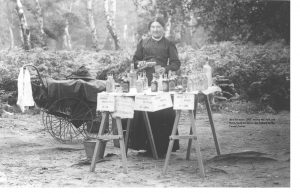
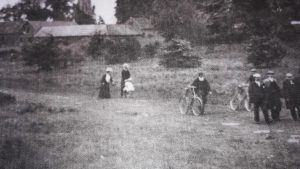
Edwinstowe Historical Society’s website continues to attract interest. One of the recent enquiries has concerned an old postcard. When the Edwinstowe Historical Society was inaugurated in the 1960’s, among the many photographs added to the collection was one that is displayed on the current website, and refers to “Mrs Robinson” selling refreshments from a stall in Sherwood Forest. However, a recent communication from a reader, included a photograph of his Great Grandmother (Mrs Bullimore) which was the same image, with an inscription naming the lady as “Granny Bullimore” and indicating her death on 28th December, 1917. Once again, the researchers got to work and discovered that the 1871 census recorded a Bullimore family lived on Mill Lane in Edwinstowe and the neighbour was Mrs Robinson. Perhaps this is a reason for the confusion over the identity. Now it’s back to the drawing board!

The Society plan to hold the first meeting of members on Wednesday, 16th February, 2022 at 2.00 p.m. in St Mary’s Church Rooms, Mansfield Road, Edwinstowe. Visitors will be welcome for a charge of £3. The duration of the meeting will be shorter than usual, lasting one hour, including a power point presentation about Edwinstowe, Tourism and Sherwood Forest. Refreshments will not be served, but anyone wishing to bring their own drink is welcome to do so. We will confirm nearer the time.
Snow Sculptures
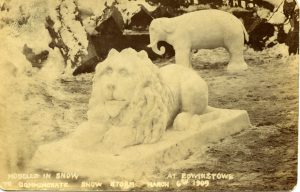
The thought of winter sends shivers down the spine for many people. This must have been the feeling in Edwinstowe in March 1909 when there was a snowstorm. To commemorate the event a member of the Tudsbury family, who lived in the village, modelled several snow sculptures, which were recorded on picture postcards.
During the 19th century the family became involved in working with wood and produced an outstanding woodcarver, Richard, who exhibited at the Great Exhibition in London in 1851. Richard John Tudsbury is reported to be the carver of the magnificent chimneypiece, which can be seen in the library at Thoresby Hall. His youngest son, Walter Albert, became a well-known local artist painting mainly woodland scenes and also carved the oak lectern, which may be seen in St Mary’s church Edwinstowe.
Additions to the website relate to the National Coal Board’s No. 3 Area headquarters for the East Midlands Division, based in Edwinstowe House. The building was occupied from the onset of Nationalisation of the Coal Industry in 1947 until January 1995.
“A Committee of Fun” and a “Gathering of the Foresters”
In November 1841 Edwinstowe witnessed a “Gathering of the Foresters”. However, this wasn’t a military operation but a bringing together of a group of people who were interested in literature, science, and art.
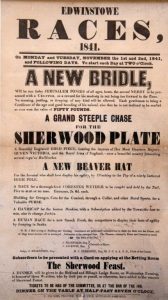 When the members of the Edwinstowe Lodge of Oddfellows met in the Jug and Glass they set up a ‘Committee of Fun’ to make plans for village festivities to be held from the 1st to 6th November 1841. During the week there would be various races, competitions and concerts, and the evening of 3rd November would be devoted to an intellectual gathering in honour of the celebrities who had added to the renown of Sherwood Forest. This became known as the ‘Gathering of the Foresters’. One hundred farmers, artisans, woodmen and agricultural labourers were present. The poet, Spencer T Hall, known as the laureate of Sherwood Forest, was the chief guest and was presented with an oak walking stick carved by local resident Richard Tudsbury, junior.
The event was so successful that on 5th July, 1842 several hundred people attended the second Sherwood Gathering which took place in a marquee in the forest. In the evening the whole party danced to the accompaniment of a band of music beneath the Major Oak. Edwinstowe was proud of its literary heritage and people walked from miles around to join the festivity. Unfortunately, the custom could not continue because all the organisers were working men dependent upon their labour, and did not have the time to fulfil their obligation.
Recent additions to the website include the Edwinstowe Labour Party, Methodist Drama Group, and Windmills.
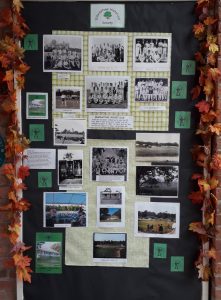 Readers of last month’s article about the Edwinstowe Cricket Club, may be interested to know that there are some copies of the Commemorative brochure (price £3) available from Stone Treasures in the Craft Centre, Edwinstowe.
An enquiry has been received from a gentleman who emigrated to Australia in 1972, having been born on the Welbeck estate, and had ancestors in Edwinstowe. He provided some interesting information about his family, which has been added to the website, and the location of family gravestones in the church yard have been forwarded to him.
Images on the website have been in demand, with one used for inclusion in a forthcoming publication about Nottinghamshire Literary History, and others for use as part of a Heritage Hub in a local Aurora Wellbeing Centre.
The school photos stirred memories, with people contacting the Society after recognising themselves or family members, and putting names to faces. This is always useful information to have. The Society continues to work with St Mary’s School which used the new Village Trail for children as part of their school work. By all accounts this was a successful project.
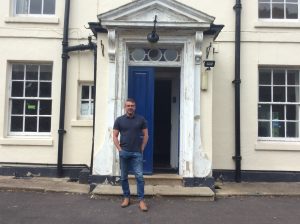
Committee members visited Edwinstowe Hall where businessman, Nik Teal, showed them the work he was undertaking to return the Hall to a comfortable residence once again, after being used for different purposes over many years.
Edwinstowe Cricket Club
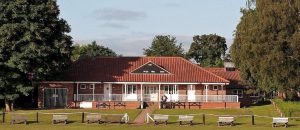
The sound of leather on willow is synonymous with the game of cricket. It conjures up an idyllic scene of sun (and often showers); of a lush green sward; of a team of white clothed players enjoying an opportunity to better their opponents – in a friendly manner of course. Which brings to mind the saying “it’s not cricket”. In other words when an action isn’t fair or sportsmanlike.
Edwinstowe’s cricket club, being situated on the Forest Corner and in the heart of Sherwood Forest, provides a perfect location for players and watching cricket. There are records which indicate cricket being played on the same field for more than 150 years, during which time the accommodation has been somewhat makeshift. A team photo of 1880 shows players proudly sitting in front of a tent used as the pavilion. At one time a small wooden structure was used, followed by a new pavilion in 1933. Then a change of site in the 1950’s from the bottom of the ground to the current location occupying the “Legion Hut”, where the present-day pavilion was officially opened in 2004.
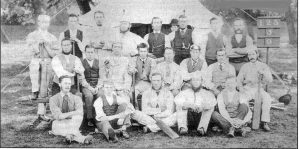
Maintenance of the grounds continues to be of high priority. In the early days Charles and Harry Mendham fetched water from the river in Harry’s horse-drawn cart, and one groundsman could be seen rolling and watering the wicket at 6 a.m. before going to work.
Many of the players were renowned for their batting and bowling, and came from families who had lived in the village for several generations. Great excitement abounded when the team had the opportunity to play against Surrey players Alec and Eric Bedser and Derbyshire’s Cliff Gladwin and Les Jackson (both test players). Those games brought in hundreds of onlookers, whose cars were closely parked all the way round the ground, which is now encircled by commemorative seats.
The opening of the new pavilion in 2004 was due to the hard work and sheer determination of those involved in obtaining funding from several agencies, including Sport England with the stipulation that the Club had to produce a sports development plan. Consequently, several members gained their E.C.B. Coaching Qualifications and links were forged with local schools to provide coaching sessions. Fund raising included “Buy a Brick” which enabled the construction of a memorial wall inside the building, and a Social Committee was formed to look after and organise social events.
Today Edwinstowe Cricket Club is part of the village community with facilities being used by other groups and organisations. The pitch is used by senior and junior cricket teams for playing friendly and league games. Friday night is practice night for the under 11’s when parents enjoy meeting for a drink and refreshments. It is no surprise that a number of other cricket clubs are keen to use the facilities. Improvements include a new batting cage; mobile pitch covers and replacement synthetic match pitch.
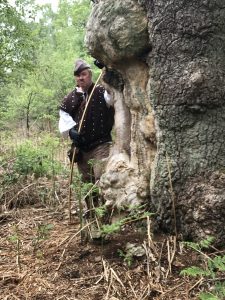 Viewers familiar with the BBC Antiques Show Bargain Hunt will be aware that during the course of the programme visits are made to local places of interest. The BBC contacted the Edwinstowe Historical Society and asked for cooperation with a section regarding Sherwood Forest. while filming at the Newark Antiques Fair in June. The interest was focussed on the sustainability of the oak trees in Sherwood Forest and how they’ve shaped the furniture landscape in some of the most iconic places, such as St Paul’s in London and Lincoln Cathedral, also the Royal Navy’s ships. The film crew visited the Church, and were shown W. A. Tudsbury’s carvings in oak. Centuries ago, travellers through Sherwood Forest would have quaked at the prospect of meeting outlaws such as Robin Hood and his merry men. However, this was not the case when the BBC team came face to face with local resident Robin Hood (Greg Abbott) who accompanied them to the Major Oak.
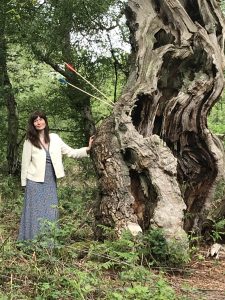 The crew spent many hours ensuring that people were in the right place for a specific time knowing that the end result would be an “insert piece” lasting a few minutes. Viewers will be interested to see the final result when televised at a future date – hopefully the contribution won’t end up on the cutting room floor.
In the absence of the Annual General Meeting in May, both the Chairperson’s and Treasurer’s reports were published in a Newsletter which was circulated to the members advising them that no date had been decided for the resumption of monthly meetings. However, they were assured they would be notified as soon as it is safe to be together.
Courtesy of the BBC – Bargain Hunt
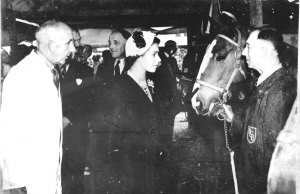
Tommy, the Thoresby pit pony, is presented to The Queen at the Royal Show Newton Abbot in 1952
This is the time of year when the majority of people usually think about their holidays. However, not so long ago it wasn’t only human beings who looked forward to a change in routine. There were pit ponies.
Pit ponies were mainly used in coal mines in the 1800s and early to mid-1900s. At Thoresby Colliery they were employed underground to haul trucks full of heavy material, with an ostler to look after them. One can only imagine how they must have felt when they were brought up the shaft on the Friday evening before the colliery’s holiday fortnight and taken to Herbert’s farm in Edwinstowe, where they were allowed to gallop and graze in a field. The astonishing fact is, though the ponies – about six in number – only saw the light of day a few times during the year, they knew the way to the farm.
Ponies would take part in shows, and at the Royal Show, Newton Abbot 1952, the Queen met ostler Jim Gibson and Tommy the last of the Thoresby Colliery pit ponies. Shortly after this event Tommy came out of the pit to be given honourable retirement.
During the past twelve months 32 enquiries have been received and answered. Arising from one request, the Society was pleased to contribute a popular photo of the blacksmiths standing in front of the Major Oak, for inclusion in a recently published book by Dr Mark Johnston MBE, “The Tree Experts: A History of Professional Arboriculture in Britain”.
The website continues to expand with additions to the Young Historian and Thoresby Colliery, i.e. the Miners’ Institute, Medical Centre, and Thoresby Colliery Band.
A date for resumption of future meetings is still on hold, and members will be notified as soon as it is considered safe to meet again.
The faiths and fates of 2 families with connections to Edwinstowe have been added to the website.
During the 18th century William Hoggard came to live in Edwinstowe and married Martha Breedon of Norton Cuckney. His blacksmith’s forge was on High Street. They had a large family and his grandson, James, and wife, Emily, moved to Lambley, where after meeting missionaries from the Church of Latter Day Saints, (or Mormons) they were baptised into the faith. They dreamed of joining other Mormons in the United States, and in 1854, James set sail across the Atlantic, to prepare a home for Emily and their children. They eventually settled in their permanent home, American Fork in Utah, where he was the first to be appointed Head Watermaster, a post which he held for twenty-one years.
On 17th July, 1632, in St Mary’s Church, Edwinstowe, Elizabeth Snowden became Oliver Hooton’s second wife. While living in Skegby, Elizabeth met George Fox, founder of the Quaker movement, which changed Elizabeth’s life and both she and Oliver became Quakers. Elizabeth was the first woman to become a Quaker minister. On many occasions she was beaten and imprisoned for propagating her beliefs, both in England and when travelling to the American colonies. She died in Jamaica in 1672.
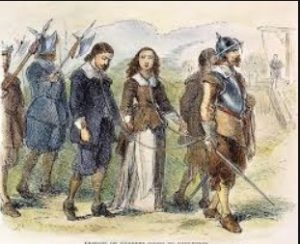
Elizabeth Hooton (nee Snowden)
After seeing a photo of his wife’s late father on the website, one gentleman requested a copy as a birthday surprise for his wife. The Society is pleased to share information and photos providing others do not benefit financially.
Sherwood Forest Trust have planted a Hawthorne tree (traditionally the May flower) in St Mary’s churchyard, and the Society agreed to provide a photographic display, in the Craft Centre, depicting Edwinstowe’s former May and Rose Queen festivals.

EDWINSTOWE IN THE 1920’S
One hundred years ago, when people witnessed the unveiling of the War Memorial at the
Crossroads, little did the residents of Edwinstowe, a quiet agricultural village, realise how
their way of life was to change when a coal mine was sunk on the outskirts of the village.
In 1925 work began to sink Thoresby Colliery. The building of 500 colliery houses started in
1926 and was completed by 1931, attracting many new families. Edwinstowe Hall was
purchased by the Bolsover Colliery Company for use as a Welfare Centre for its employees,
and was visited by the Prince of Wales who congratulated the Company on the Welfare
Scheme (1923).
Spectators would watch Edwinstowe St Michael’s football team, and the village cricketers
whose matches were played in idyllic surroundings on Forest Corner. The Edwinstowe
Allotment and Garden Holders’ Association held their annual shows and the annual fair was
a welcome attraction, so too were the charity Garden Fetes, whist drives and concerts in the
church. St Mary’s Church, the Primitive and Wesleyan Methodist chapels were meeting
grounds as were the Edwinstowe Women’s Institute and the Edwinstowe Mothers’ Union
which were inaugurated in 1920 and 1924, respectively, also the British Legion.
When walking down the High Street one would see Dowse’s Drapery Store; tea room;
shoe shop; Staley Lowe’s garage; bakers; the Co-op; Freeman’s and Newton’s butchers’
shops; Mr Lowe’s barber’s business conducted in a hut which was reached by wooden steps
behind one of the cottages; the Institute which was a men’s meeting place with a billiard
room; Telephone Exchange; Jack Lacey’s, cobbler; Tudsbury’s China Shop; Kisby’s and
Fenton’s sweet Shops; a Motor Mechanic’s Workshop; Parnell’s grocer; Newsagents; the
Methodists’ chapel; the Royal Oak; Jug and Glass; and Black Swan. A little further on there
were the Dukeries Hotel and the Robin Hood Inn. The village Lock-up provided overnight
accommodation for any miscreant who fell foul of the law,
The Fire Service was called into action in 1929 when the Dukeries Hotel caught fire and
suffered extensive damage.
Education was provided by St Mary’s School, and in 1926 a temporary building was erected
for the “new village children”, with the first portion of a permanent Council School in use by
1928.
During the course of 10 years a new sewage and water works had been opened and
Mansfield Road as far as Warsop Windmill was widened to accommodate the increase in
traffic. Although travel by train and carrier to Mansfield was the only method of public
transport, the 1930’s would see the introduction of omnibus services to nearby market
towns. A cinema would be built, the colliery would provide electricity to the village, tennis
courts, putting and bowling greens, and a sports’ ground.

Lowes Garage and Kirkstall Café on right c1920s
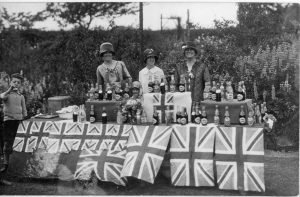
British Legion Members. The Old Vicarage, 1929
This year Edwinstowe Historical Society is participating in the Virtual Great Nottinghamshire Local History Fair to take place throughout May. The contribution will be a Power Point Presentation of images, focusing on Edwinstowe’s popularity as a tourist attraction, and will be viewed on the Inspire website. In the 19th century people began to appreciate the natural beauty and splendour of the forest, with writers, poets and artists gaining inspiration from the surroundings. Also, cyclists in newly formed cycling clubs came from the towns and villages around the forest, some as far away as Doncaster.
Recent additions to the website relate to Birkland House and the Parnell family, also Ashgrove House. Once again, we are appealing for any photos of Ashgrove house which readers might have. Ashgrove House was a Queen Anne/Regency House on West lane, and was demolished in the 1960’s to make way for the new vicarage.
Requests for information continue to be received. One related to the history of Edwinstowe House (now known as the Edwinstowe House Business Centre) where, incidentally, the Historical Society’s archive is based, thanks to the generosity of Robert Woodhead Construction Company. (The history of the property is displayed on the website). A correspondent conducting family research hoped to locate a burial headstone in the churchyard for an ancestor who died during the late 18th century. (A check will be made of the list of graves kept in the church as soon as access is permitted.) Another enquiry concerned a relative who was employed as a lady’s maid at Cockglode House during the 19th century, when the Foljambe family were in residence. (Although the enquirer was disappointed that Cockglode had been demolished, he was able to view photos and the history of the building on the website.)
 Edwinstowe Historical Society