At the June meeting the speaker, Cal Warren, Building and Exhibition Developer, spoke about her involvement with the Nottingham Castle Project. She described the various stages 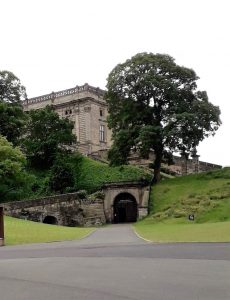 undertaken to reveal the diverse history of the Castle, which were encapsulated in the various galleries. The Rebellion Gallery covered the more riotous moments in history; the Craft Gallery displayed medieval alabasters and salt glaze pottery; the Lace gallery was dedicated to the story of Nottingham’s most creative industry. Access to the caves within the castle rock had been improved. Cal stated that the biggest surprise (and sometimes disappointment) for visitors was when they had passed through the gatehouse they saw a 17th century Palladian mansion and not a castle similar to the ones portrayed by Hollywood.
The Society’s researchers have dealt with a number of enquiries from people with connections to the village. Additional information has been added to the website giving an insight into people’s memories of village life (see “Memory Lane” and “Memories of School Days”). There is more to read about the Tudsbury family, also WW2, and the street layout of the village in “Maps”.
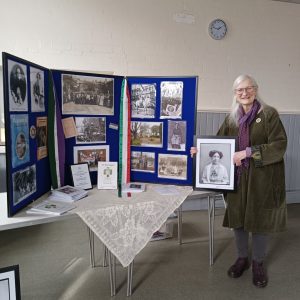 At the March meeting of the Edwinstowe Historical Society, Shirley, the Chairperson, welcomed Dr Rowena Edlin-White whose talk related to Women‘s Suffrage in Nottinghamshire. While the suffragists, National Union of Women’s Suffrage Societies, (NUWSS) led by Millicent Fawcett used peaceful methods such as lobbying in their campaign for the right of women to vote, the suffragettes Emmeline Pankhurst and others, decided more direct action was required and founded the Women’s Social and Political Union (WSPU) with the motto ‘Deeds not words’. Sometimes this led to unlawful and violent acts which attracted much publicity.
Rowena had stories to tell about some of the Nottinghamshire women who had taken part in the campaign and the problems they experienced along the way. They were subjected to imprisonment, hard labour, and force-feeding.
It was not until the Equal Franchise Act of 1928 that women over 21 were able to vote and women finally achieved the same voting rights as men.
Enquiries have been received in connection with an Italian prisoner of war at Rufford Abbey; location of family graves and grave stones in St Mary’s church yard; Kelmscott Manor relating to a William Morris Fire screen; a church memorial; the meaning of a cradle roll certificate; and from the BBC Countryfile team in connection with a forthcoming programme. All have been answered
The Annual General Meeting will take place on Wednesday, 17th May and, as agreed previously with members, this will be combined with a “Fuddle” in place of the usual annual lunch. After the business of the meeting there will be a short illustrated talk.
At a well-attended meeting of the Edwinstowe Historical Society in February, Shirley, the
Chairperson, welcomed members to the illustrated talk, which highlighted the parts played
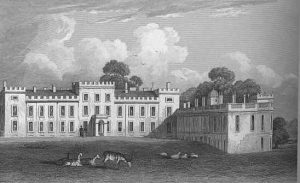
by the Dukes of Newcastle, and Dukes and Earls of Portland in the development of Welbeck
Abbey after the dissolution of the monasteries to the present day. Sir Charles Cavendish,
son of Bess of Hardwick, purchased the abbey in 1607.
Over the centuries Welbeck Abbey has been redeveloped, and has seen Dukes devoted to
horses, farming, and estate improvements, also Dukes and Earls who have been avid
collectors, lived expensively and found themselves in debt. Fortunately, their successors
were able to restore order to the running of the estate.
On occasions there were no male heirs, so the estate passed by marriage through the
female line. There were some notable females: Margaret Duchess of Newcastle, a
philosopher, poet, scientist, fiction writer and playwright; Lady Henrietta Harley, Countess
of Oxford revived Gothic architecture; Lady Margaret Cavendish Bentinck, 2nd Duchess of
Portland, collector and naturalist.
The British royal family, King of Siam, and Kings and Queens of Portugal, Spain and Belgium
were entertained at Welbeck. Between 1914 and 1919 the army set up camp in the park,
and after WW2 Welbeck operated as Welbeck College, an army training college, until 2005.
The 6 th Duke and Duchess were involved with the creation of Harlow Wood Orthopaedic
Hospital and Portland Training College.
The title Duke of Portland became extinct with the death of the 9 th Duke in 1990. However,
the Earldom of Portland was inherited by a male line descendant of the first Duke’s younger
brother. On the death of Lady Anne Cavendish Bentinck in 2008, she bequeathed Welbeck
to her nephew William Henry Marcello Parente.
Time passes and tastes change, which is apparent when looking at some of the business
adverts printed in Edwinstowe’s St Mary’s church magazine during the first half of the 20th
century. In addition to the general groceries, residents could purchase fresh trapped
rabbits, tripe and cow heels. A Bath chair was available for hire, so, too, was an electric
orchestra for dances and socials, and an Electrolux vacuum cleaner available for 2/6d per
day (12½p). If you had a radio, an accumulator was needed which would require charging.
This would be called for, charged and returned. Looking for entertainment, then high on
the list was a visit to the Major Cinema which offered “major pictures of the World’s market
in comfortable surroundings”.
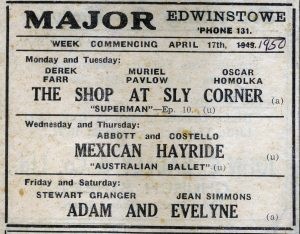
Certainly, a different way of life compared with today’s advanced technology, and
international cuisine available in the supermarkets. But it is possible that products and
services during the first few decades of the 20th century may have been considered an
improvement on the preceding years. Interesting to wonder what future generations will
think about the current era.
A recent addition to the website www.edwinstowehistory.org.uk relates to Fred Kitchen,
born in Edwinstowe in 1891. He was a farm labourer, who became a writer and
broadcaster.
The talk on 15 th March will be presented by Rowena Edlin-White, entitled “Women’s
Suffrage in Notts – No Surrender”
Welbeck Abbey is the subject chosen for Edwinstowe Historical Society’s illustrated talk on 15th February, being one of the 4 ducal seats contained in the area referred to as “The Dukeries”.
In November, last, the Society participated in St Mary’s Christmas Tree Festival, the chosen theme being “Sherwood Forest and Edwinstowe’s Historical Celebrities”. In view of the interesting personalities associated with the village over the past 200 years, the decision was taken to use their details for display on the notice board in the Forest Corner Craft Centre.
Website additions have been made to the following sections: Schools (Sunday School Treat Sept. 1914) ; Pubs and Hostelries (register of Victuallers’ licences granted for the village) ; WW1 and WW2 ( an update of the fallen); St Mary’s Church (a prickly object found in the Church turned out to be a barrel organ attachment).
A search through old newspaper reports can often result in interesting news. This happened recently when one of the Society’s researchers discovered that in the early 1800’s one of a Newcastle shipbuilder’s vessels was named “Edwinstow”. In 1803 she was licensed by the East India Company as a whaler to proceed to the Southern Whale Fishery. The following year she was reported whaling in the Pacific before being detained by the Spanish at Concepcion and sold as a prize. Final reports note that she “burnt” in 1807. During her life she had acted as a tender to a convoy carrying the 65th regiment of foot, (2nd Yorkshire, North Riding) destined for foreign service, and on one occasion rescued survivors from sinking ships caught in a gale in the Bay of Biscay.
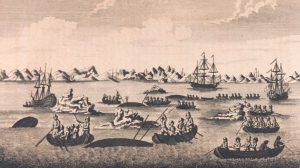
One might question why a vessel from Newcastle would bear the name “Edwinstow”. Perhaps it may have been due to the fact that Newcastle once formed part of Northumbria – its King was Edwin. He marched south to fight King Penda of Mercia and was killed at the battle of Hatfield, possibly near Edwinstowe, at a small hamlet called Cuckney, in AD 632. In AD 633 Edwinstowe (Edenstou) which was a small settlement within the forest bounds, was named after King Edwin of Northumbria.
At the Novemer meeting of the Edwinstowe Historical Society, members and visitors
welcomed Dennis Hill whose talk focussed on Major Hayman Rooke, who was born in
London in 1723. He was well educated, mixed with royalty, and joined the army at the age
of 12, working his way through the ranks becoming a Major in 1761. After retirement, in
1777 he moved to Woodhouse Place, in Mansfield Woodhouse, where he lived until his
death in 1806.
He was a man of many interests and was involved in the community. His knowledge of
natural history and meteorology enabled him to become a Fellow of the Society of
Antiquarians and a Fellow of the Royal Society. In his travels around the country, he made
many observations and discoveries, one of the main ones was finding a Roman villa on land
just west of Mansfield Woodhouse. He was a keen artist, the proof of which is to be found
in his books about local great estates such as Welbeck, Bolsover, Haddon Hall and Thoresby,
and his pamphlet entitled “A Sketch of the ancient and present state of Sherwood Forest”.
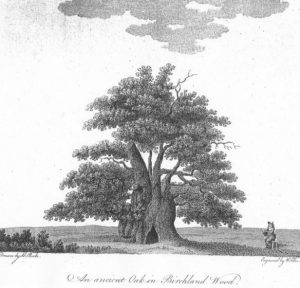
Reputedly, the Major would often be seen sitting beneath the “Queen’s Oak” (or Cockpen
tree) which led the local villagers to refer to the tree as “The Major’s Oak”, later becoming
known as “The Major Oak”. A remarkable legacy.
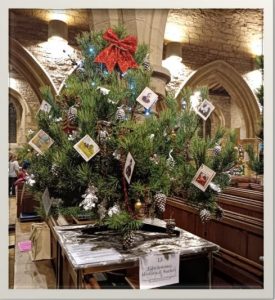 The Society took part in St Mary’s Christmas Tree Festival, decorating a tree provided by the RSPB.
The chosen theme was “Sherwood Forest and Edwinstowe’s Historical Celebrities”.
SHERWOOD LIFE – DECEMBER, 2022
Shirley Moore, Chairperson for the Edwinstowe Historical Society, welcomed the members to the October meeting, and introduced Bob Massey whose talk was about Skegness. She also asked the members present for their views on having a “fuddle” during the summer months, rather than the lunch in January. It was unanimously agreed that a summer “fuddle” was preferable.
Skegness – a harbour?, smuggling?, steamer trips from the pier?. All true, as Bob Massey explained. Originally Skegness was sited farther east at the mouth of the Wash, where a headland protected the harbour which, in the 14th century, was an important port for coastal trade. Erosion in the Middle Ages and a storm in the 1520’s led to the rebuilding of the new shoreline.
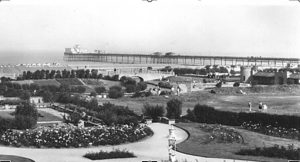 At first Skegness was a small fishing and farming village, but became an important centre for smuggling goods from Europe during the 18th century. The Vine Hotel in Skegness was the haunt of a famous gang of smugglers. At this time a large portion of land was enclosed, and people began visiting the village because sea air was thought to have health giving-qualities, and bathing machines were available. With the coming of the railway in 1873 the Earl of Scarborough funded development of the town. The Pier opened in 1881, and daily steamer excursions would operate across the Wash to Norfolk. Sadly, devastating storms in 1978 and 1987 damaged the pier and its concert hall, leaving just a shortened length of structure. Additional attractions were Pleasure Gardens, and bathing pools, and a landmark for the town was the Jubilee Clock Tower. Newspapers carried advertisements for properties, and shops began opening. In 1908 the famous “Jolly Fisherman” poster was used by GNR to advertise day trips from King’s Cross in London. The new Skegness became a popular destination for holidaymakers and day trippers from the East Midlands’ factory towns, and although the amenities and attractions have changed with the times, the town continues to be popular with thousands of visitors each year.
Rather strange to think that when people refer to Skegness as “Skeggy” they could be using the Old Norse word skeggi (meaning “bearded one”) used to describe the shape of the landform.
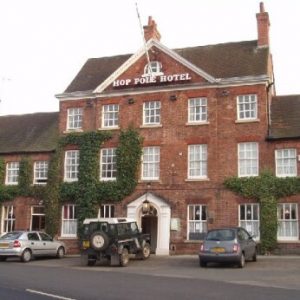 At the September meeting of the Edwinstowe Historical Society, Linda Hardy, a member of the Sherwood Forest Trust, gave a detailed account of the introduction of hop growing into England and the reason for the popularity, locally, in the 1700’s. Previously the national drink had been ale (a brew produced from malt without hops) but the introduction of hops preserved the beer. The growing method was to train hops to grow up poles.
Hop Pole Hotel, Ollerton. “Wikimedia Commons”
Extending from Retford to Southwell, known as the “North Clay” district, 35 parishes including Ollerton and Edwinstowe, contained hop yards. Records indicate that in 1881, Edwinstowe’s hop yards were sited on land off Mill Lane and Boy Lane. A noted hop grower was the Earl of Scarborough, at Rufford Abbey. Hop markets or fairs were held in Retford, Tuxford and Ollerton and attracted merchants from various parts of England.
Hop growing declined towards the end of the 19th century, possibly due to the advent of the railways, and changes in taste. The only reminders now of a once flourishing trade are signs to be found on some hostelries, i.e. the Hop Pole in Retford, and the Hop Pole in Ollerton.
Enquiries continue to be received, one from the leader of Souchez Historic Committee in France. His enquiry related to Lieutenant Sidney Reuben Pinder of the Royal Flying Corps who, sadly, lost his life during the first world war when he was shot down at Marquillies in France, on 19th February, 1918. Sidney was born in Edwinstowe on 31st August 1889. He went to Canada in 1911 but as soon as war was declared he left his job and enlisted with the 3rd Canadian Tunnelling Company. Tributes will be paid in November 2022 to the allied airmen buried in the Cabaret Rouge Cemetery at Souchez, France. Sidney is one of them.
“Detectives at Work”
Two recent enquiries (one from New Zealand) received by the Edwinstowe Historical Society concerned ancestors connected with Edwinstowe. The Society was able to provide information which was a complete surprise to both parties and helped to fill in some of the gaps in their search for information about their relatives.
When first contacted for information, the Society’s researchers refer to St Mary’s church registers for births, marriages and deaths which will help to confirm if a person lived in the parish. The record of burial plots in the church yard is helpful for people requesting their ancestor’s resting place, and sometimes it is possible to provide a photo of the headstone, if not eroded by time. A look at the village census will provide details of a person’s abode, marital status, and occupation at a given time, together with mention of any other family members. Searching older editions of newspapers often reveals interesting comments about people. In fact, the accounts rendered are so full of detail that one wonders how the reporters managed to record so much information without the help of modern-day recording systems. These can often refer to incidents in a person’s life, e.g., the sale of a property; attendance at civic ceremonies; a military award; even an appearance in court for being drunk, or an upset with one’s neighbour.
Recent additions to the website www.edwinstowehistory.org.uk relate to local artists Frank Wright and Sylvia Lake Armstrong.
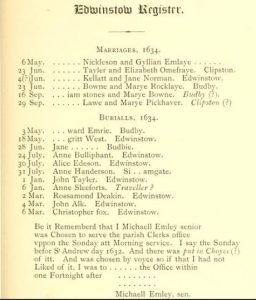
‘A present from Edwinstowe’
After an enjoyable holiday or a day out, people often purchase something which serves as a memento. In the late 19th and early 20th centuries visitors to Edwinstowe would buy picture postcards or a piece of crested ware which would be on sale in one of the shops on the High Street. The china souvenirs were in a variety of shapes and sizes, all embellished with a coat of arms, incorporating the Major Oak, stags, crowns, pheasant and Robin Hood. A. Tudsbury & Sons boasted of royal patronage, and tempted the visitor with their carvings in oak. Mr B Stocks, landscape photographer offered views of the village, the ducal houses and, as his speciality “a large selection of photographs of Forest Scenes”. A visit to one of the local hostelries and cafes would probably be made before making for home and, if returning by train, what better place to call than the Dukeries Hotel, en route to the station.

Edwinstowe Historical Society’s programme of talks for 2022/23 has been finalised, and at the meeting on Wed. 21st September Linda Hardy will talk about the Hop industry in the area. Additional talks will take members on visits to Nottingham Castle and Skegness (the latter will be a trip down memory lane for some), and present the opportunity to learn more about the Suffragette movement and Major Hayman Rooke, whose name is synonymous with the Major Oak.
 Edwinstowe Historical Society