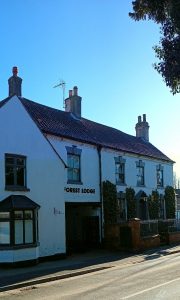
 In January members of the Edwinstowe Historical Society met for lunch at the Forest Lodge hotel in Edwinstowe. A former coaching inn thought to have been built in 1774, it has provided accommodation and sustenance for travellers for many years. During that time the proprietors have changed, so too has the name of the establishment, in turn being known in 1885 as Forest House – a boarding house with dining and refreshment rooms; Forest Side Café -providing high class refreshments (1937); Forest House Café (1947); Bullivants restaurant (1993); and subsequently Forest Lodge
Just one of the many establishments in the village, which catered for visitors to Sherwood Forest including many well-known 19th century writers, poets and artists who gained inspiration from the surroundings. The opening of the station for passenger service in 1896 brought trippers into the village. For past generations the first choice for refreshment when leaving the station might have been a visit to the Station Tea Rooms, or the splendid Dukeries Hotel, followed by a stroll into the village passing the Black Swan Inn, the Jug and Glass, Birkland House temperance tea rooms, the Royal Oak and the Forest Lodge. Next would be a walk in the forest to see the Major Oak, perhaps stopping to purchase a drink from Granny Bullimore’s stall on Forest Corner, while keeping an eye open for one of the popular cycling clubs.
In January members of the Edwinstowe Historical Society met for lunch at the Forest Lodge hotel in Edwinstowe. A former coaching inn thought to have been built in 1774, it has provided accommodation and sustenance for travellers for many years. During that time the proprietors have changed, so too has the name of the establishment, in turn being known in 1885 as Forest House – a boarding house with dining and refreshment rooms; Forest Side Café -providing high class refreshments (1937); Forest House Café (1947); Bullivants restaurant (1993); and subsequently Forest Lodge.
Just one of the many establishments in the village, which catered for visitors to Sherwood Forest including many well-known 19th century writers, poets and artists who gained inspiration from the surroundings. The opening of the station for passenger service in 1896 brought trippers into the village. For past generations the first choice for refreshment when leaving the station might have been a visit to the Station Tea Rooms, or the splendid Dukeries Hotel, followed by a stroll into the village passing the Black Swan Inn, the Jug and Glass, Birkland House temperance tea rooms, the Royal Oak and the Forest Lodge. Next would be a walk in the forest to see the Major Oak, perhaps stopping to purchase a drink from Granny Bullimore’s stall on Forest Corner, while keeping an eye open for one of the popular cycling clubs.
Forest Lodge
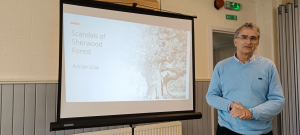 Shirley Moore, Chair for the Edwinstowe Historical Society, welcomed members and visitors to the October meeting and introduced Adrian Gray, with his illustrated talk ‘The Top Ten Scandals from Sherwood Forest’.
Adrian left his audience in no doubt that events between the 17th and 19th centuries kept the press and the gossips busy. His talk shed light on the highs and lows of society, with the aristocracy at Bestwood Lodge, Clumber House, Thoresby Hall, Newstead, Welbeck and Rufford Abbeys, all making a contribution.
There was an incestuous relationship, a bigamous marriage, suggestion of a double life, men arrested when dressed in ladies’ clothes, a title bestowed on an illegitimate offspring, and a divorce requiring an Act of Parliament. Plenty of scope here for today’s authors!
The current display in the Sherwood Forest Art and Craft Centre is devoted to sport, and has a selection of photographs of the village cricket and football teams. Cricket has been played in Edwinstowe for more than 200 years and one of the first official football matches took place in 1893.
Shirley reminded members that the Society’s Data Protection Policy, and the Constitution, have now been added to the website. An enthusiastic response was received when members were asked if they were interested in attending a lunch in January. Further details would be circulated in the next few weeks.
Shirley Moore, Chair of the Edwinstowe Historical Society, introduced Ian and Diane Hibbert whose selection of Elizabethan music was a prelude to David Templeman’s talk about “Arbella Stuart – the Queen That Never Was”. David explained that Bess of Hardwick orchestrated a marriage between her daughter, Elizabeth Cavendish, and Charles Stuart son of the Countess of Lenox, in the knowledge that any child of Charles Stuart had a claim to the throne after the death of the childless Elizabeth 1. The marriage was arranged at Rufford Abbey, and their daughter Arbella was born in 1575.
Following the death of her parents, at the age of six Arbella became the ward of her grandmother Bess. She was highly educated and spent time at the court of Queen Elizabeth, but was banished for misbehaviour and became exiled at Hardwick, which she found frustrating. During the reign of her cousin, King James I, she married William Seymour, 2 nd Duke of Somerset, in secret. The King imprisoned William and placed Arbella under house arrest. They managed to keep in touch but their planned dramatic escape to France did not succeed and Arbella was recaptured and imprisoned in the Tower, although William managed to reach safety on the continent. Arbella never saw William again, and she starved herself to death at the age of 39.

At a well-attended meeting in September, Shirley Moore, Chair, welcomed Bob Massey who left no stones unturned when he revealed some of the murders, mysteries and mayhem in the Nottingham area during the past centuries. Sherwood Forest was the home to many outlaws during the 13th and14th centuries, especially the Coterel and de Folville gangs. Surviving court records covering Sherwood Forest indicate that many of the events reported bear resemblance to the tales of Robin Hood. Cannibalism in Nottingham? In the 14 th century the city was subjected to the worst famine in history, with inevitable consequences. Crime and punishment, death and mourning were referred to in detail. From 1558 until 1827 executions took place on Gallows Hill, Mansfield Road, Nottingham on the site of Rock Cemetery entrance, before moving to High Pavement in the city. As a warning to travellers if they broke the law, there was a gibbet at the junction where Mansfield Road (A60) joins the old Rufford Road (A614) at Leapool roundabout.
A recent request has been received from John Hayman, Associate Professor in the Dept. of Clinical Pathology, University of Melbourne, Australia, seeking permission to include in Wikitree the Society’s information relating to his ancestor, Henry Telford Hayman. The Rev. Hayman was a well-respected vicar at St Mary’s Church, Edwinstowe from 1884 until 1907. John also asked to join the Edwinstowe Historical Society as a “colonial member”. Needless to say, there was no hesitation in welcoming him as the first Honorary Colonial Member. Another honorary member is Margaret Woodhead, the sole remaining founder-member of the Edwinstowe Historical Society.
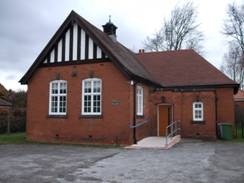
St Mary’s Church Rooms – venue for Edwinstowe Historical Society meetings
Thanks to the Speaker Finder, members of the Edwinstowe Historical Society will enjoy a variety of illustrated talks during the forthcoming months.
To start the ball rolling Bob Massey will talk about ‘Murder, Mystery and Mayhem’ – a tale of dark events in Nottinghamshire villages. This is followed by Adrian Gray who will report on ‘Top Ten Scandals from Sherwood Forest’.
David Templeman will discuss why Lady Arabella Stuart was the Queen that never was, and the in-house presentation describes a journey along the River Maun which was used to power many mills along its course.
Denis Hill has something to say about Newstead Abbey, and Mo Cooper discusses ‘The Good, The Bad and The Reality’ – women who have contributed to Nottingham’s history, and finally John Baird will take a literary journey through Nottinghamshire when he ‘Follows the Moon and Stars’.
Requests for information about Edwinstowe families continue to be received. Appreciation has been extended to two readers who provided details of an accident which took place at Simon Fosters’ Oak in 1879, and a photo of the Maun Bridge c.1900. These have been added to the website.
 Six decades have elapsed since the Edwinstowe Historical Society was founded, and little did those early members realise how the Society would develop. A collection of old postcards set the wheels in motion and, after attending the Workers’ Educational Association local history courses, the Society was formed.
Over the years hundreds of documents and photos have been added to the archive and this has enabled a fascinating picture to be constructed of past village life and the surrounding area.
The grant from the Heritage Lottery Fund helped the Society to develop a website – with far-reaching results. Not only were local people contacting the Society, but enquiries came from across the globe asking for information about relatives who once lived in the village. During the past 12 months the researchers have dealt with 44 enquiries, 18 of which were related to families.
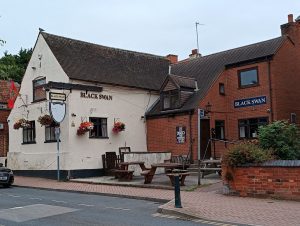
The Society’s current photographic display in the Sherwood Forest Art and Craft Centre relates to the village inns – notably the Black Swan which is the oldest building on the High Street, with parts of the Inn believed to be 500 years old. The building has been altered and extended considerably over the years.
Talks resume on Wednesday 20th September when Bob Massey will have something to say about ‘Murder, Mystery and Mayhem’.
Six decades have elapsed since the Edwinstowe Historical Society was founded, and little did
those early members realise how the Society would develop. A collection of old postcards
set the wheels in motion and after attending the Workers’ Educational Association Local
History courses the Society was formed.
Over the years hundreds of documents and photos have been added to the archive and this
has enabled a fascinating picture to be constructed of past village life and the surrounding
area.
The grant from the Heritage Lottery Fund helped the Society to develop a website with,
literally, far-reaching results. Not only were local people contacting the Society, but
enquiries came from across the globe asking for information about relatives who once lived
in the village. During the past twelve months the researchers have dealt with 44 enquiries,
18 of which were related to families.
The Society’s current photographic display in the Sherwood Forest Art and Craft Centre relates to the village inns, notably the Black Swan which is the oldest building on the High Street, with parts of the Inn believed to be 500 years old. The building has been altered and extended considerably over the years.
Talks resume on Wed. 20th September, 2023 when Bob Massey will have something to say
about “Murder, Mystery and Mayhem”.
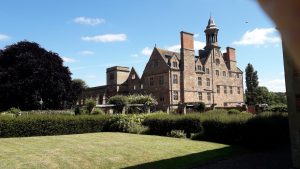
Rufford Abbey was the subject of the illustrated talk presented to the members of the Edwinstowe Historical Society at a recent meeting. Once the home of a group of Cistercian monks until the dissolution of the monasteries when it came into the possession of the Earls of Shrewsbury and later the Saville family. During the centuries changes were made to the structure of the Abbey resulting in a country mansion which was favoured by royalty. Sadly in 1938 the Abbey was sold, changing hands on several occasions, eventually falling into decay resulting in partial demolition. Today, it is central to a country park, in the ownership of Nottinghamshire County Council, and managed by Parkwood Outdoors in co-operation with English Heritage. The afternoon closed with a recording made by the former nurse employed for a time to look after Lord and Lady Savile in the late 1920’s and 1930’s, during which she gave a vivid description of life, upstairs and downstairs, during her stay.
Recently the Society deposited a collection of photos with the Nottinghamshire Archives. These contained images of Sherwood Forest, views of the old Visitors’ Centre, the Robin Hood Festival, and Rufford Abbey. All may be accessed through the Inspire Picture Archive.
Enquiries continue to be received, with the latest from Australia relating to a family member buried in St Mary’s church yard. Another concerned a programme planned for BBC2 television. Information, also, was provided for local school children to learn more about the village.
No meeting will take place during August. However, the new programme of talks commences on Wed. 20th September, when the speaker will be Bob Massey whose talk is “Murder, Mystery and Mayhem”.
At the Annual General Meeting of the Edwinstowe Historical Society held in May, Shirley
Moore, the Chairperson, reported that during the past year 30 enquiries had been dealt
with. These were in connection with families who had lived and were buried in the village;
the provision of information for a Young Adult adventure novel; guidance for an English
literature student asking about Elizabeth Sarah Villa Real; and an enquiry from the son of an
Italian prisoner of war researching his father’s time in Sherwood Forest and Rufford. The
Society was the first port of call from the BBC Countryfile researchers in connection with a
recent programme about Sherwood Forest. The Committee members were re-elected, and
the programme of talks commencing in September finalised.
After the meeting a slide show took a light-hearted look at village life, with the emphasis on
people’s hats over the past century. These varied from bowlers, boaters, trilbies and caps
for the men, and elaborately decorated picture hats, boaters, and cloche hats for the ladies.
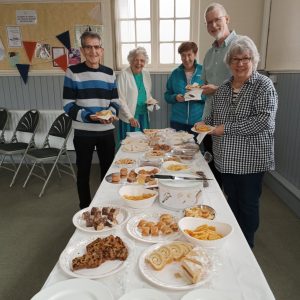
Liz Stewart-Smith was the winner of the Quiz. The afternoon came to a close with a
“fuddle”.
There are no meetings during July and August. The new programme of talks commences on
20th September when the speaker will be Bob Massey whose talk is “Murder, Mystery &
Mayhem “.
 Edwinstowe Historical Society