 Edwinstowe Historical Society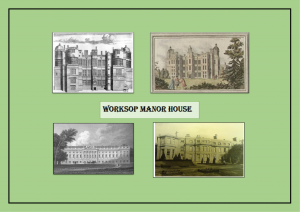
Worksop Manor is one of the five estates included in the area known as “The Dukeries”, formerly the home of the Earls of Shrewsbury and the Dukes of Norfolk.
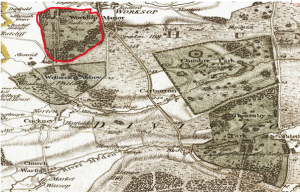
Chapman’s map dated 1774, shows the layout of the estates
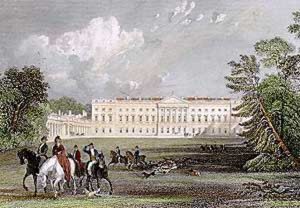
Worksop Manor in the 1830s
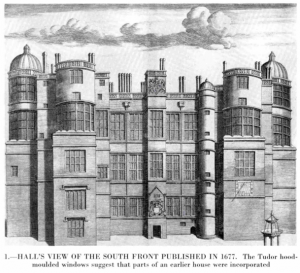
Worksop Manor in 1677.
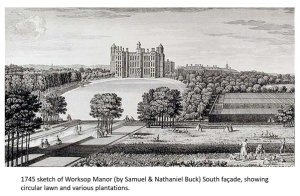
The house, probably designed by Robert Smythson, was built in the late 16th century for the 6th Earl of Shrewsbury, whose second wife was Bess of Hardwick. The building burnt down in 1761. The house was much admired, especially for its long gallery which was 224 feet long and 38 feet wide on the top storey, giving magnificent views over the Earl’s parkland. One chimneypiece had the date 1585. For some time in 1568 it was the prison of Mary Queen of Scots.
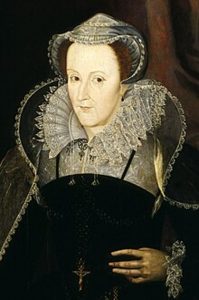
Mary Queen of Scots.
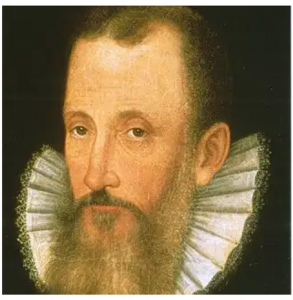 George Talbot
The Christmas after Shrewsbury’s marriage to Bess, Queen Elizabeth informed him that he had been chosen as custodian of Mary, Queen of Scots ‘in consequence of his approved loyalty and faithfulness, and the ancient state of blood from which he is descended’. After fifteen years, the Earl of Shrewsbury was relieved of his duties as Mary’s warder when it was discovered that while Mary was staying at Worksop Manor in 1584, she was visited by the brother of Shrewsbury’s first wife, the Earl of Rutland, who was a Catholic.
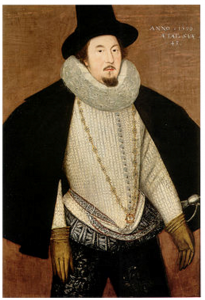 Gilbert Talbot
When the 6th Earl died in 1590, his son Gilbert, 7th Earl of Shrewsbury, inherited Worksop Manor. He had married Mary Cavendish, daughter of his stepmother, Bess. On the death of Queen Elizabeth I, James VI of Scotland was named her successor and the proclamation was signed by Gilbert.
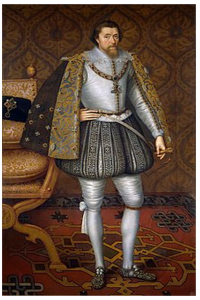 King James
As Worksop was a convenient stopping place on the King’s journey to London to take the throne of England in 1603, Gilbert was able to show his hospitality and allegiance to the new king, particularly as his niece Arbella might be regarded as James’ rival for the throne.
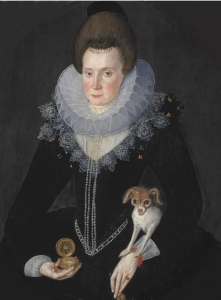 Arbella Stuart
Cousin to Alethea Talbot. Both ladies in waiting at court.
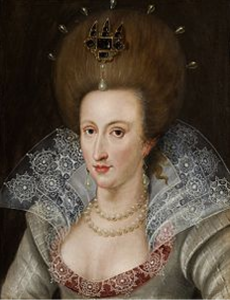 Ann of Denmark
Ann was 14 years of age when she married James in 1589. She stayed at the manor in June 1603, holding court on the king’s birthday, 19 June. She gave William Cecil, the young son of Sir Robert Cecil, a jewel and tied it in his ear, and he danced with the 7-year-old Princess Elizabeth. Members of the Scottish royal family accompanied Anne, but her large crowd of followers was disorderly, and the Duke of Lennox and the Earls of Shrewsbury and Cumberland made a proclamation at Worksop that her followers should put aside any private quarrels, and hangers-on without formal roles should leave.
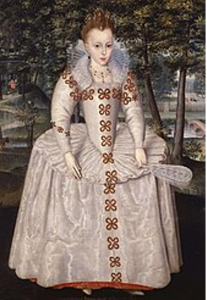 Princess Elizabeth, aged 7 years.
Elizabeth was the second child and eldest daughter of James and his wife, Anne.
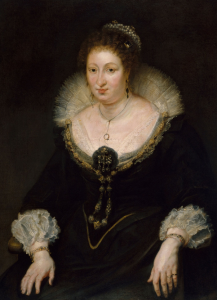 Alethea Talbot
In 1606 Lady Alethea Talbot, daughter of Gilbert, married Thomas Howard, lst Earl of Norfolk and 14th Earl of Arundel. Thus the Dukes of Norfolk became owners of Worksop Manor. Her dowry was 60,000 crowns per year, worth £2 million in today’s currency. Together with her husband, Alethea built one of the most important art collections in 17th-century England. She was one of England’s first published female scientists.
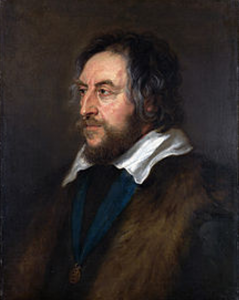 Thomas Howard, 14th Earl of Arundel and 1st Earl of Norfolk.
A diplomat and courtier during the reigns of King James I and King Charles I, but he made his name as a Grand Tourist and art collector rather than as a politician. By all accounts Alethea’s money helped to finance his purchases. When he died, he possessed 700 paintings, along with large collections of sculptures, books, prints, drawings, and antique jewellery. Most of his collection of marble carvings, known as the Arundel marbles, was eventually left to the University of Oxford.
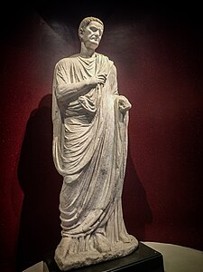
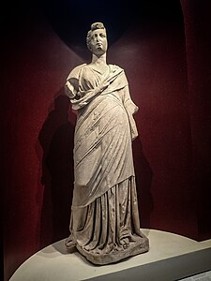
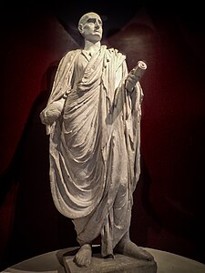
Selection of the Arundel marbles.
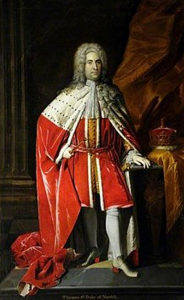 Thomas Howard, 8th Duke. In 1701.
Thomas doubled the size of the house, built stables and laid out large gardens. He married Maria Shireburn, of Stonyhurst Hall, on 26 May 1709, when she was age 16 and a half, with a fortune of more than £30,000. At the time of the Jacobite Rising of 1715, he used his influence to secure the acquittal of his brother Edward on the charge of high treason. The Duke himself was arrested on 29 October 1722 under suspicion of involvement in a Jacobite plot, and was imprisoned in the Tower of London.
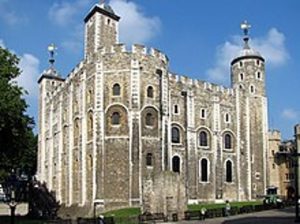
The Tower of London
His wife, refused permission to visit, prevailed upon the Earl of Carlisle to act as surety for his bail in May 1723. His childless marriage is said to have been unhappy, and his wife, a staunch Catholic and Jacobite, separated from him when he—in her words—”truckled to the Usurper”. Another factor was that following the death of her mother in 1728, Maria had inherited the income from the Stonyhurst estate, but by 1730 her husband had taken possession of it. He sold off furnishings and moved some items to Worksop Manor, leaving Maria with jewellery and plate.
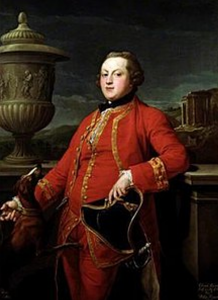 Edward Howard
Edward, 9th Duke, took part in the Jacobite Rising of 1715, one of several English noblemen to do so. Through the intercession of his brother, he escaped the punishment for high treason. He succeeded as 9th Duke of Norfolk in 1732, after the death of his childless elder brother Thomas Howard. He too improved he gardens, making Worksop Manor his principal country home.
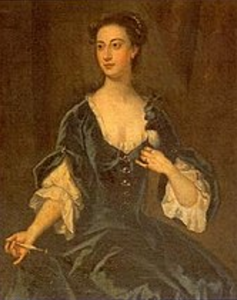 Mary Duchess of 9th Duke.
The Duchess was intelligent and assertive and interested in the arts. She proceeded to renovate Worksop Manor House, and in August 1761 the Duke and Duchess gave a magnificent party to celebrate completion of the building work. Sadly, two months later when staying in Bath fire broke out and the house was completely destroyed. The fire which started in the library raged for two days, fanned by strong winds. The financial loss was calculated at £100,000 – an enormous amount given the fact that £22,000 had been spent in the previous two years on decorating the apartments.
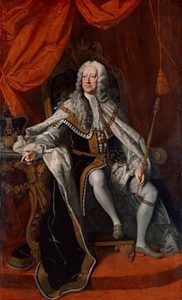 George II. King of Great Britain & Ireland 1683 – 1760.
Mary and Edward were socially active, using their position as the highest-ranking peers in the kingdom to promote religious tolerance. As Roman Catholics whose immediate predecessors, the 8th Duke and his wife Maria Shireburn, had supported the Jacobite rising of 1715, Mary and Edward Howard were keen to express their support of the Protestant monarch King George II, and In 1733 they were received at court showing that the 9th Duke’s past behaviour had been forgiven.
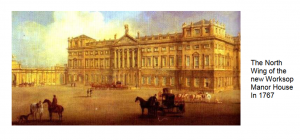
James Paine house. Later in 1761, the Duchess commissioned James Paine to build a replacement for the burnt-out Elizabethan mansion. Being a childless couple, this was for the benefit of their nephew Thomas Howard, heir presumptive to the dukedom. Paine planned a roughly quare mansion with a vast hall in the central courtyard, and also included a colonnaded screen (designed to hide the stable court behind) leading northwards from the north east corner of the house. The service wing of 1701-4 was retained. However, only the north wing had been completed when work stopped on the house in 1767, following the deaths of Thomas and his half-brother Edward in 1763 and 1767, respectively. The Duchess was never the same again, dying a few years later, but the Duke continued to improve the estate until his death at the age of 91 years.
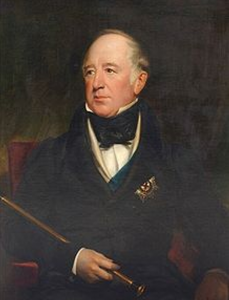 Bernard Howard. 12th Duke.
On the death of the 9th Duke in 1777, the estate passed to a distant cousin, aged 57, and living in Surrey, neither he nor his immediate successors lived at Worksop and it became neglected. The 12th Duke gave it to his son, the Earl of Surrey in 1815.
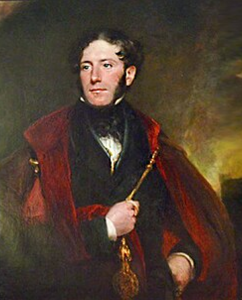 Henry Howard
13th Duke, aka Earl of Surrey. In 1838, the Earl of Surrey sold the Worksop estate to the Duke of Newcastle of nearby Clumber Park for £375,000, who ruthlessly stripped the house. He demolished the main wing of the house with gunpowder, having sold off the roof lead and some fittings, as he was only interested in adding the land to his own estate. He made a huge loss on the purchase which seems to have been animated by anti-Catholic-sentiment, the Duke or Norfolk having been a leading Catholic aristocrat. In 1854, the Earl of Surrey agreed to lease land to Sheffield Cricket Club near Bramall Lane for ninety-nine years, a site which is now home to Sheffield United Football Club.
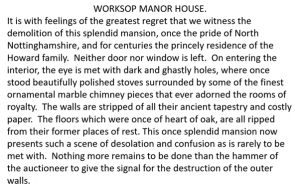
Lincolnshire Chronicle report dated Friday, 11th June, 1841.
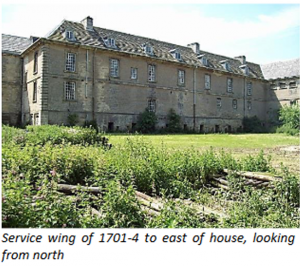
Service Wing. However, after a number of years the surviving parts of the house, were reformed. The east court (formerly the service wing) was retained and part was adapted to form a new mansion, which was leased for a number of years by Lord Foley, formerly Captain of the Honourable Corps of Gentlemen at Arms, and afterwards by William Isaac Cookson, a manufacturer of lead. In 1890 a large part of the estate was sold by auction. The house and adjoining parkland was bought by Sir John Robinson, a Nottingham businessman, and remains in the family. Since at least 1890 the estate has been home to the Worksop Manor Stud.
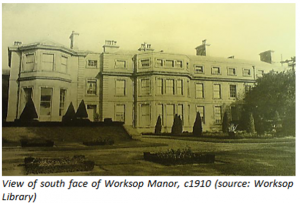 The Manor in 1910
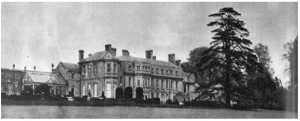 The Manor in 1960
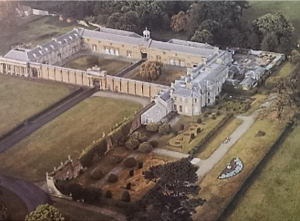 Aerial view 1990
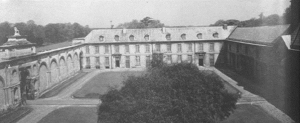 The colonnade on the left
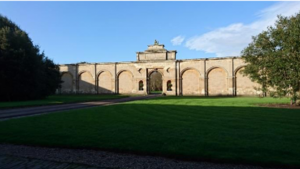
East elevation of colonnade, west side of courtyard
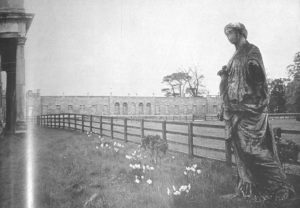
View of the North Wing
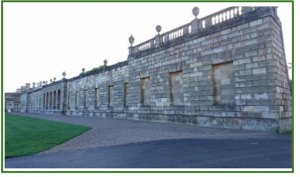 Remains of ground floor of 1763 Paine House, now a garden wall.
Other small parts of the Paine scheme remain, including the former north wall of the house (up to ground level only). Now a garden wall, with the roof urns and finials placed on top.
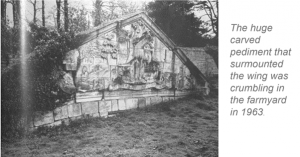
The carved pediment designed by the Duchess of Norfolk and carved by William Collins in 1765, now sited on the ground.
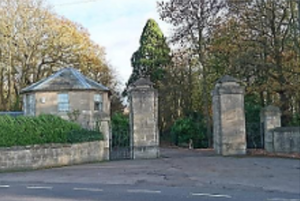 Westwood Lodge, Mansfield Road.
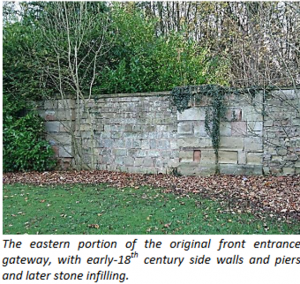
Eastern portion of original front entrance gateway. The Duchess also designed a menagerie, the remains of which sat to the west of the current main entrance driveway.
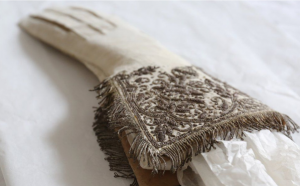
Glove worn by Elizabeth 1 for her coronation in 1559.
The coronation glove is a single white glove worn on the right hand by the British monarch during part of the coronation. Presenting the glove to the monarch was a right associated with the Manor of Worksop (this practice dates back at least to the coronation of James II.) . The head of the Howard family, the Duke of Norfolk, held the Manor of Worksop. For the 1953 coronation, Henry Pelham-Clinton-Hope, 9th Duke of Newcastle petitioned the Court of Claims for the Manor of Worksop’s traditional right of presenting the coronation glove. (You may remember that the Duke of Newcastle had purchased Worksop Manor). The claim was denied as the duke had placed his estates into a limited company and the court determined for that coronation to not award any rights to limited companies. At the 1953 coronation the glove, now embroidered with the royal cypher, was presented to the monarch by the Chancellor of the Duchy of Lancaster. For his coronation, Charles III used the glove made for his grandfather George VI. Lord Singh of Wimbledon represented the Sikh faith and presented the Coronation Glove.
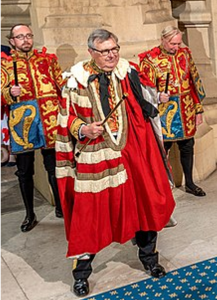
The 18th Duke of Norfolk. Edward William Fitzalan-Howard in his role as Earl Marshal, the Duke holds a hereditary duty for arranging the state funerals of sovereigns, as well as the accession and coronations of new monarchs.