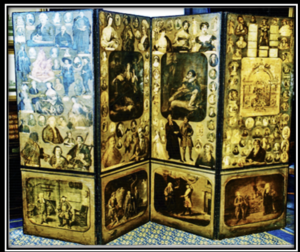
Lord Byron’s Screen” was the subject of the power point presentation delivered to
members of the Edwinstowe Historical Society, recently. In the eighteenth century a
fashionable way of displaying prints was to stick them onto the wall of a “print room” or
mount them on a screen of wood and canvas or paper. Coats of lacquer were then applied.
A method known as “decoupage”. Byron’s interest in the theatre and prize fighting was
reflected in his screen, which is now on view at the National Portrait Gallery.
There are no meetings in December and January. At the meeting on 18th February the
Society welcomes the return of David Templeman whose illustrated talk relates to Mary
Queen of Scots – Part 2.
In September, at a well-attended meeting, members of the Edwinstowe Historical Society
welcomed Mo Cooper whose talk “The Clergyman, the Widow, and the Milkman” related to
the landlords of working-class housing in Edwardian Nottingham, based on Narrow Marsh,
St Ann’s and the Meadows areas. Mo’s research indicated that whilst individual men owned
the majority of property, women had a significant role. Their investment in bricks and
mortar would take into account the location and type of housing required, resulting in a
complex mixture of property ownership, which could have been a clergyman, widow or a
milkman.
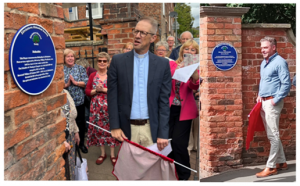
On the first day of September, with the aid of a community grant, two blue plaques were
sited in the village. Olwen Hawkes, Chairperson of the Edwinstowe Historical Society
commented on the history of the two buildings and the reasons why they were worthy of
Blue Plaque recognition. Rev Stuart Ellis, Superintendent Minister of Sherwood Forest
Methodist Circuit unveiled the first which was placed on the Old Methodist Chapel on High
Street, now holiday accommodation by Village Holidays managed by Ross Morton and Laura
McLafferty. The second plaque was destined for Edwinstowe Hall, which after many changes
had returned to being a family home owned by Rachael and Nik Teal, who unveiled the
plaque.
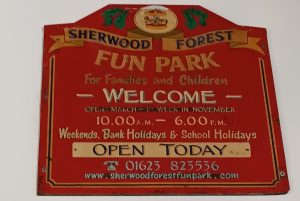
In Mike Jackson’s booklet “Story of a Forest Village” mention is made of a 2 day fair in
Edwinstowe each year towards the end of October. It was held in the churchyard where a
small cluster of stalls and booths would bring something different, a little variety into the
lives of the villagers before the hard days of winter set in. That was in the 14 th century. In
more recent times a fair would be held in a field near the village, and then a more
permanent site on the forest corner became an attraction for visitors during the summer
months. Sadly, the popular fair ground, looked after by the same family for more than 60
years, closed in 2023.
Shirley Moore, former Chair of Edwinstowe Historical Society, had always considered that
there should be a memorial to the men who lost their lives working at Thoresby Colliery.
This was discussed with the Revd Claire Melless, vicar of St Mary’s Church, who did not
hesitate to agree to hold a commemoration service to mark 10 years since the colliery
closed and 100 years since it opened, also to remember all those who worked at the colliery
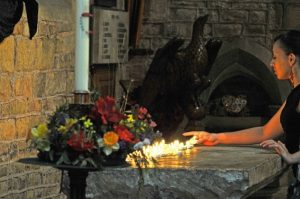
and those who lost their lives there. Revd Claire Melless led the service which was held on
Sunday, 13th July. The Thoresby Colliery Band, under the leadership of Stan Lippeatt,
accompanied the hymn singing, and Tom Stanforth shared colliery memories with the
congregation. Darren Martin and Trevor Baker read out the names of the men who lost
their lives at the colliery, for whom candles were lit in their memory. Bible readings were
read by Olwen Hawkes and Molly Wright. Terry Wheatley and David Betts, both ex colliery
Managers at Thoresby Colliery, were among the congregation, which included former
miners, families and friends, all of whom were invited to sign the Book of Remembrance
that had been placed in church. A recording of the event was televised on East Midlands
Today later that evening.
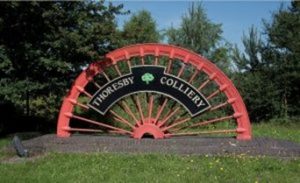
Located in the heart of Sherwood Forest, Thoresby Colliery was the last Nottinghamshire
colliery to be sunk by the former Bolsover Colliery Company between 1925-28, and was the
first pit in the country to be built with electric winding – in other words, the first pit without
a smoking chimney.
In 1951, Thoresby became the first nationalised mine to exceed an output of one million
tons in one year. One of the most productive and profitable coal mines in Europe for many
years, in 1988 went on to produce two million tons in 43 working weeks.
On Friday 10 th July 2015, Thoresby was the last mine to be closed in the Nottinghamshire
coalfield. The end of an era for the coal mine sunk amongst the birches of Sherwood Forest,
known as a record breaking “Jewel in the Crown”.
Acknowledgment to Simon Ford for the photographs.
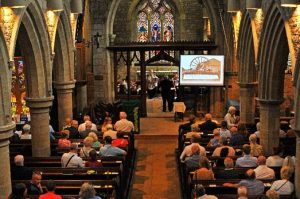
St Mary’s Church, Edwinstowe, was the venue for Edwinstowe Historical Society’s meeting in June. Terry Ashton, a steward at the church, outlined the history of the church, which in 1175 had been built in stone to replace an earlier structure on the site. Worthy of special note are several stained-glass windows and memorials as well as finely carved heads on the window arches and pillars.
At the Annual General Meeting of Edwinstowe Historical Society in May, retiring Chairperson, Shirley Moore, thanked the committee for their support during her tenure of eleven years. A floral bouquet was presented to Shirley as a mark of appreciation for the dedicated work she had devoted to the Society, having gained in 2015 a grant of £10,000 from the Heritage Lottery Fund towards developing the skills to preserve the Society’s collection. Also, to create a website www.edwinstowehistory.org.uk, which now includes reference to Rufford Abbey.

The past year had been busy answering enquiries from people regarding relatives who had lived in the village, displaying photos on the notice board in the Craft Centre, taking part in St. Mary’s Christmas Tree Competition, recommending Edwinstowe Hall for inclusion in the Notts Building Preservation Trusts’ Harry Johnson award, working with schools, and currently seeking permission to provide two more blue plaques in the village. The afternoon concluded with a buffet and raffle.
 Thoresby Hall and Park was the subject of the illustrated talk presented to members of the Edwinstowe Historical Society at a recent meeting. Thoresby was one of the 5 noble estates in the area which became known as the Dukeries. The Pierrepont family originally came over with William 1 in 1066, and the first Earl purchased the land from the Crown in 1633 to form Thoresby Park. The present building is the third home to be built there, and after changing hands several times finally became an hotel. The Royal Lancers and Nottinghamshire Yeomanry Museum is based in the courtyard at Thoresby Hall.
Shirley Moore, Chair of the Edwinstowe Historical Society, reported that plans were in hand to place blue plaques on two buildings in the village. Information relating to Pageants and Village Celebrations had been added to the Website.
Shirley Moore, Chair of the Edwinstowe Historical Society, opened the meeting by delivering the sad news of the recent death of Mrs Margaret Woodhead. Margaret was a founder member of the Historical Society, with a vast knowledge of history, especially in respect of Edwinstowe and its inhabitants, for which she had written several booklets.
Shirley then welcomed David Templeman whose talk was devoted to Mary Queen of Scots, the Captive Queen in England. David gave a detailed account of Mary’s years in captivity in and around York, Staffordshire, Derbyshire and South Nottinghamshire. This truly was a story of intrigue, passion, and plots.
During May, celebrations are taking place to commemorate the 80th anniversary of the end of WW2, with the current photographic display in the Sherwood Forest Craft Centre reflecting some of the pageants and events that have taken place in the village.
Recent changes to the website relate to “Inns and Hostelries” with additional photos being added to the Forest Lodge Hotel. Under the heading “Churches” a newspaper article refers to the start of Methodism in Edwinstowe originating approximately 200 years ago.

At a recent meeting of the Edwinstowe Historical Society Adrian Gray spoke about the life of Richard Bernard who was born in Epworth. He was a great figure amongst puritans and separatists under James I. As a writer he influenced John Bunyan and wrote an authoritative book about witches based on his experience in Worksop. Richard’s daughter helped found Rhode Island, a state in America.
The researchers have been busy again, dealing with a request from a gentleman living in Holland wishing to know more about his great grandfather who died in Edwinstowe. Great grandfather had been born in Galicia (present day Ukraine) in 1904 and following the German invasion in 1939 and subsequent Russian “liberation” he came to the UK in 1944. The family had lost contact with him until notified of his death in 1981. The Society’s enquiries led to the lane where he had lived and a neighbour remembered him and knew burial had taken place in the Forest cemetery. The grave was located and after cleaning the headstone a photo was forwarded to the enquirer who was delighted to show it to his grandmother so she could see where her father was buried. This year Edwinstowe will receive an extra visitor who will have a special reason to visit the village as well as exploring Sherwood Forest.

This year, the annual lunch for members of the Edwinstowe Historical Society took place at the Dukeries Lodge Hotel, Edwinstowe. Built in 1897 by the Mansfield Brewery Company to accommodate the thousands of visitors to the “Dukeries” area, the family hotel and refreshment rooms harmonised with Sherwood Forest’s famous woodland scenery. Outside were stables, coach houses, and pleasure grounds with tennis courts. Disaster struck on 22nd February 1929 when fire broke out in the early hours of the morning, destroying a large part of the building. The hotel was rebuilt on a modified plan and without the pavilion which had been intended to accommodate groups of 200 people. See www.edwinstowehistory.org.uk. for more details about the hotel and the village.
The Society’s archivists continue to deal with a variety of queries, not just from this country but recently from Australia and Brazil. People asking about relatives who once lived in the village have learned where their burial plots are. Students often request help with their research, whilst others ask for more detailed information about local buildings and landmarks. Requests for the use of photographs displayed on the website are appreciated, and the Society is delighted when someone sends photographs which are not already in the collection.

Dukeries Hotel & Pavilion 1909
 Edwinstowe Historical Society